Sudoku strategies: the 7 techniques, from the easiest to the X-Wing
Every sudoku can be solved with a handful of techniques. Here are the 7 that the Dojo in Melodoku teaches, from the white belt to the black belt, in the order to learn them.
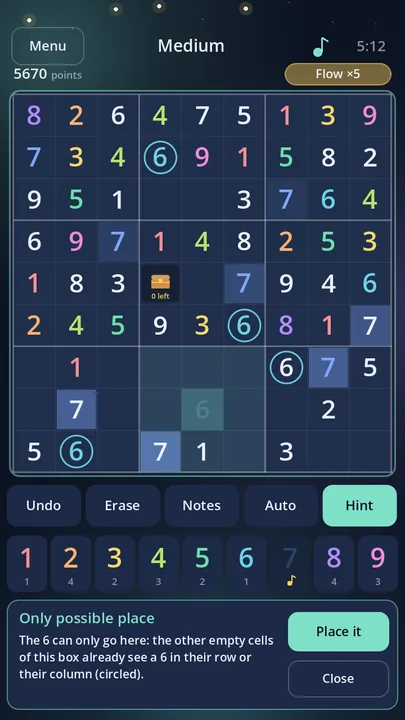
1. Hidden single (only possible place)
Choose a digit and a zone (a row, a column or a box). If this digit can only go in one square of the zone, it's necessarily there. This is the most used technique: it solves easy grids almost on its own.
2. Naked single (only one possible digit)
Look at an empty square and rule out all the digits already in its row, its column and its box. If only one remains, it's the right one.
3. Pointing (lined up in a box)
In a box, if all the places for a digit are on the same row (or column), the digit is necessarily on that line inside the box. So you can cross it out everywhere else on that row.
4. Claiming (stuck in a box)
It's the other way round: if, on a row, all the places for a digit are in the same box, this digit can't be anywhere else in that box. Cross it out in the box's other squares.
5. Naked pair (twin pair)
Two squares in the same zone accept only the same two digits: those two digits are reserved for them. Cross them out in the other squares of the zone.
6. Hidden pair
In a zone, two digits have only the same two places: those two squares can only contain them. Cross out all their other notes.
7. X-Wing
If, on two rows, a digit has only two places, in the same two columns, it necessarily occupies two corners of the rectangle. Cross it out elsewhere in those two columns. It also works the other way, with two columns and two rows.
In what order should you learn them?
- Easy and Medium grids: hidden single and naked single are enough.
- Hard grids: add pointing and claiming, then pairs.
- Expert grids: the X-Wing comes in. It's rare, but sometimes it's the only way forward.
- Practise one technique at a time. In Melodoku's Dojo, each belt has an introduction and 3 exercises on real positions; the first 3 belts are free.
- While you play, the coach says “Nice spot!” when you find a technique on your own, and the Hint explains the one you missed.
FAQ
What is the most useful sudoku technique?
The hidden single (only possible place): pick a digit and look where it can go in a row, a column or a box. It solves a large part of every grid.
What is an X-Wing in sudoku?
When a digit has only two places on two rows, in the same two columns, it occupies two opposite corners of a rectangle. You can then cross it out from the rest of those two columns.
Do you need to guess in a hard sudoku?
No. A well-made sudoku can always be solved by logic. If you're stuck, a technique you haven't spotted yet is hiding somewhere: pairs and the X-Wing are the most often missed.
Make your next puzzle sing
Melodoku is coming soon to Google Play.